
en.wikipedia.org
RS-25 — Wikipedia
Comprehensive technical reference for the RS-25/SSME: full specifications, component descriptions, variant history, incident log, and SLS configuration details.
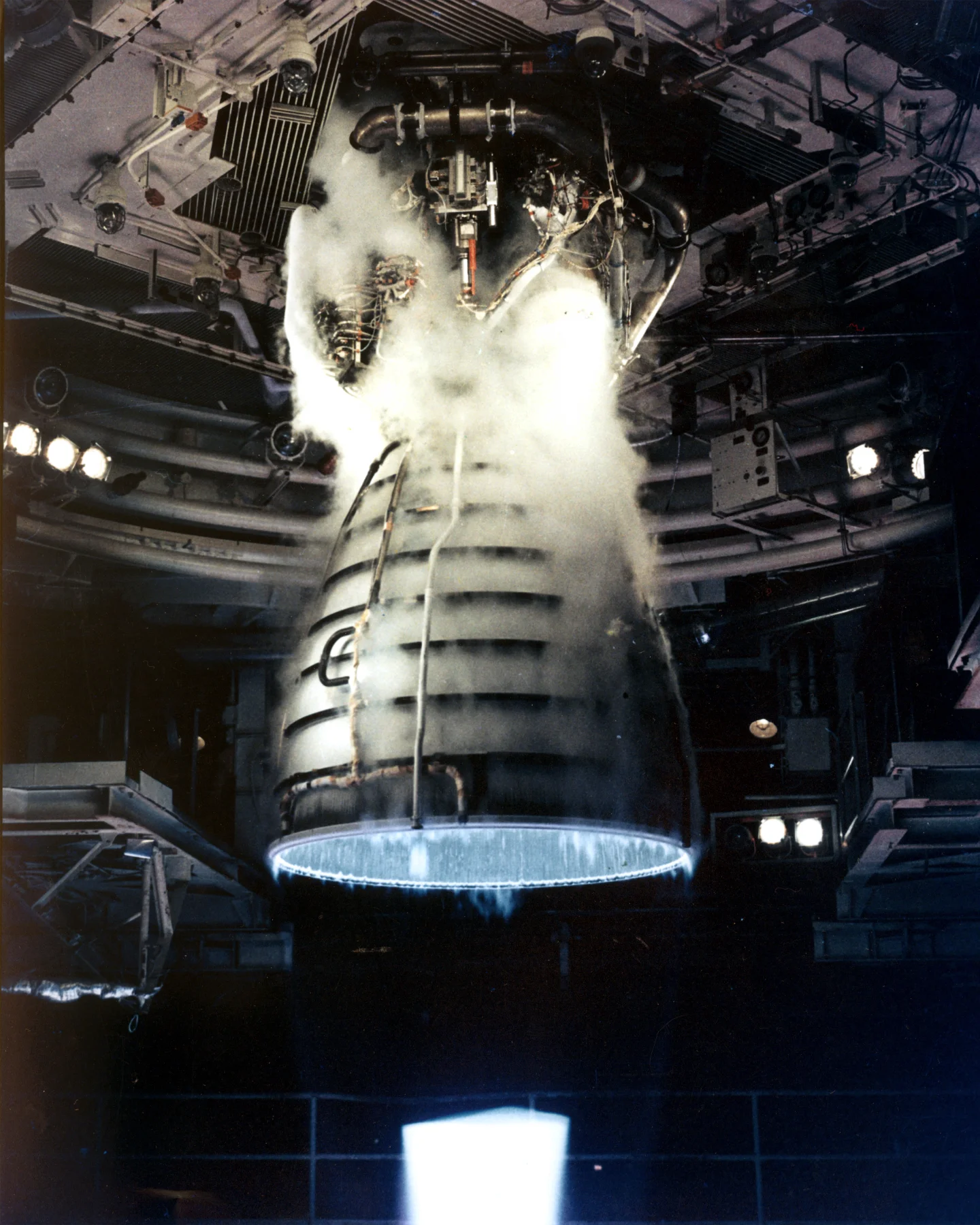
A 4,675-word case study of the RS-25 / Space Shuttle Main Engine — the highest-chamber-pressure liquid-propellant rocket engine ever flown operationally (2,994 psi). Covers NASA's 1971 staged-combustion decision, the turbopump development crisis (HPFTP at 35,360 rpm, 71,140 hp), the NARloy-Z combustion liner surviving 3,300 °C gas, the failed 55-mission reusability target, and the pivot to the expendable RS-25E powering SLS today.
| Chamber pressure | 2,994 psi (20.64 MPa) |
| Vacuum thrust at 109% RPL | 512,300 lbf (2,279 kN) |
| Sea-level thrust at 109% RPL | 418,000 lbf (1,860 kN) |
| Vacuum specific impulse | 452.3 s |
| Sea-level specific impulse | 366 s |
| Dry weight | 7,004 lb (3,177 kg) |
| Thrust-to-weight ratio | 73 |
| HPFTP speed | ~35,360 rpm |
| HPOTP speed | ~28,120 rpm |
| Throttle range | 67%–109% RPL |
| Mixture ratio (LOX/LH2) | 6.03:1 |
| Engine length | 168 in (4.3 m) |
| Nozzle expansion ratio | ~77.5:1 |
Comprehensive technical reference for the RS-25/SSME: full specifications, component descriptions, variant history, incident log, and SLS configuration details.